Oak vs Ash: How to Tell Them Apart
Oak and ash are two of Britain's most familiar large native trees, and in summer you can separate them from twenty paces. Winter is a different business. Strip away the leaves and both become grey, ridged, unhelpfully similar shapes in a hedgerow. Neither tree is trying to trick you, though. Learn four features — leaves, buds, bark and seeds — and you can name either one with confidence, in any month of the year.
Leaves: the quick summer test
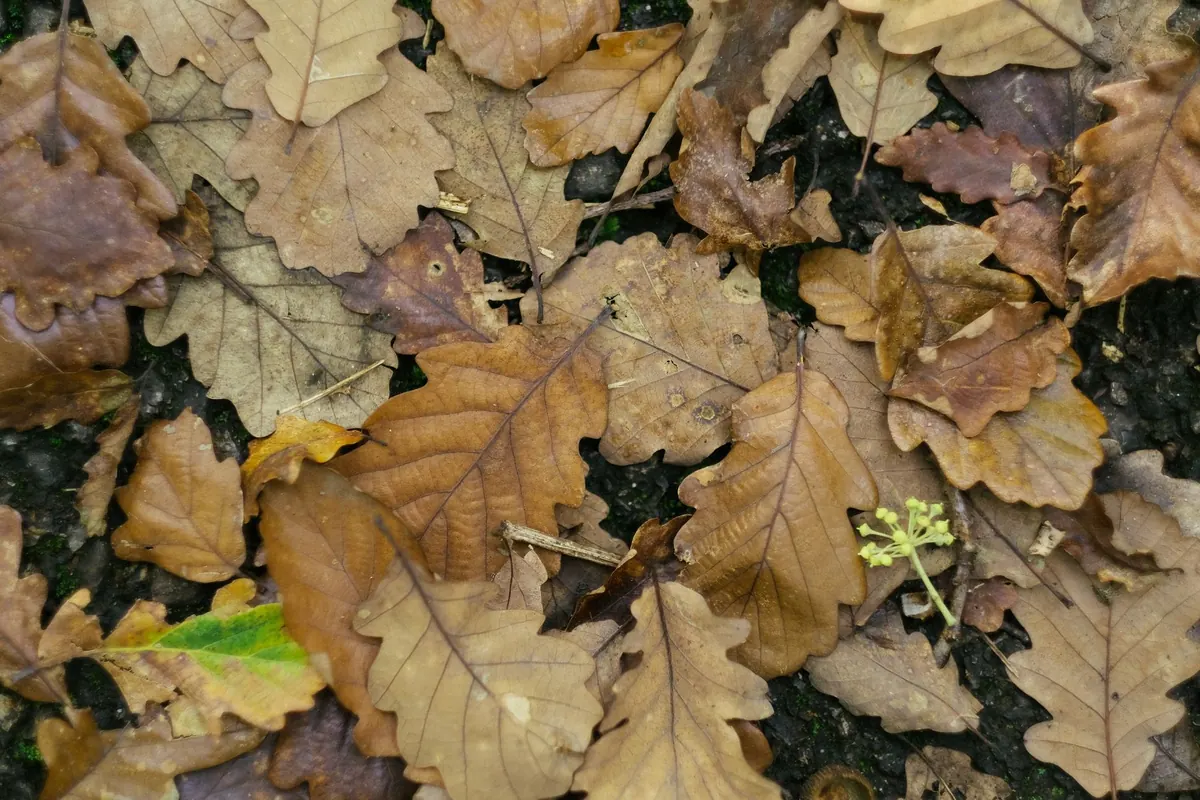
An oak leaf is a single leaf with rounded, wavy lobes and a leathery feel. Our two native oaks differ in the details: English oak (Quercus robur) has an almost absent stalk, just a few millimetres, with small lobes right at the base where the leaf meets the twig. Sessile oak (Quercus petraea) has a longer stalk and a leaf base that tapers. Either way, the lobes are rounded and smooth-edged. If you find a lobed leaf with pointed, bristle-tipped lobes, you are looking at a red oak, an American arrival that is common in parks and streets.
Ash is completely different, and the confusion usually comes from mistaking one of its leaflets for a whole leaf. An ash leaf is compound: typically seven to thirteen leaflets, most often nine or eleven, arranged in opposite pairs along a central stalk with a single leaflet at the tip. Each leaflet is lance-shaped with a distinctly toothed edge.
The bud-at-the-base trick
Look at the point where the stalk joins the twig. If a bud sits in that junction, the whole thing is one leaf — oak. If there is no bud, you are holding a leaflet of something larger — ash. This single check settles the question in seconds once you know to look for it.
Timing helps too. Ash is one of the last trees to leaf, often not until well into May, and it drops its leaves early, frequently while they are still green. Oak tends to leaf earlier and holds its leaves longer, sometimes keeping dead brown leaves on the tree into winter.
Buds and twigs: the winter answer
Break off a twig and look at how the buds sit along it. Oak buds are alternate, spiralling around the stem. Ash buds sit in opposite pairs, directly across from each other at the same point on the twig. Opposite branching is unusual among British natives — ash, field maple and elder are the main examples — so this one check narrows things down fast.
Ash buds are the giveaway. They are fat, conical and so dark they read as black, with a velvety surface. The terminal bud at the tip of the twig is usually the largest, sitting there like a small dark beak. Oak buds are brown and ovoid, and they cluster. Several sit together in a tight bunch at the tip of a twig, with more spaced along the sides, giving the shoot a knobbly look.
A quick winter twig checklist:
- Arrangement: opposite pairs means ash; alternate and spiralling means oak.
- Colour: black and velvety points to ash; brown and glossy to oak.
- Buds at the tip: one large terminal bud suggests ash; a cluster of several suggests oak.
- Texture: ash twigs are smoother with slightly flattened nodes; oak twigs are stouter and more angular.
You may have heard the old rhyme: ash before oak, we're in for a soak; oak before ash, we're in for a splash. It is folklore rather than forecast — leafing dates depend on local weather, soil and the individual tree — but it is a pleasant thing to have in your head while you are standing in a wood in April.
Bark: useful, but never on its own
Bark is popular because it is always there. It is also the least reliable single clue, so treat it as confirmation rather than proof. Mature oak has deep vertical fissures and thick, blocky ridges, often furrowed enough to hold a hand. Colour runs from grey-brown to almost black when wet, and old oaks are usually carpeted in moss and lichen. Young oaks are smooth and grey-green, which catches people out.
Ash bark is paler and thinner-looking. Young trees have smooth grey bark that often carries a green tinge from algae. As the tree ages, the bark breaks into a network of interlocking ridges rather than straight furrows — sometimes described as diamond-shaped, like a net pulled tight over the trunk. Standing back, ash generally looks lighter and smoother than oak.
Ash dieback disease has spread widely across Britain in recent years, and it shows in the tree's outline as well as its twigs. Affected trees often have thin, sparse crowns, blackened shoots and dead tops, with new growth sprouting low down the trunk. If you are looking at a struggling tree with opposite branches and black buds, the answer is ash.
Seeds and fruit
Acorns sit in a scaly cup. On English oak they hang on long stalks — the name pedunculate gives the game away. On sessile oak, the acorns sit directly on the twig with no stalk at all. They ripen in autumn and disappear quickly, taken by jays, squirrels, deer and pigs.
Ash keys are winged seeds, each a single blade in a papery wing, hanging in dense bunches. They are green in summer, brown by autumn, and often still on the tree in midwinter, twisting as they fall so the seed spins away from the parent. One caution: ash trees are not all the same sex, and some carry mostly male flowers. A tree without keys is not automatically not an ash, so check the buds instead.
Stand back and look at the shape
Oak is broad and heavy, with a wide, domed crown and limbs that fork low and spread outwards. In winter it looks like a clenched fist. Oak is also the tree that grows galls: round oak apples on the twigs, knobbly knopper galls on acorns, and small spangle galls on the undersides of leaves. No other common tree does quite the same thing.
Ash grows taller and slimmer, with branches that sweep upwards and an airy, open crown. Young ash in a hedge often shoots up straight with few low branches, looking almost whip-like. The timber tells the same story: oak is dense and durable, ash is pale, springy and shock-resistant, which is why it was traditionally used for tool handles, oars and cart shafts.
How to practise
Pick one tree you pass regularly and work through the checks in order: branching arrangement first, then buds, then leaves or seeds if they are there. Aim to confirm with three features before you commit to a name, because bark alone will lead you astray and a single leaflet can look convincingly like a leaf. Once you can read a winter twig, the identification season stops being a summer-only activity — and hedgerows you have walked past for years start to look far more interesting.
Photo: Sami Aksu / Pexels
Getting Started with Birdwatching in Woodlands
A practical beginner's guide to woodland birdwatching: the kit worth carrying, the best times to go, and...
A Year in the Woodland: Monthly Nature Checklist
A month-by-month guide to UK woodlands, from January catkins and April bluebells to autumn fungi and the...