How to Build a Log Pile for Wildlife
A log pile is what happens when you decide to do less and get more. Tidy gardens and tidy woods are, from a beetle's point of view, close to deserts: dead wood gets swept up, chipped, burned or stacked out of the way and forgotten. Leave a few logs somewhere quiet and half-shaded instead, and within a season you have beetle larvae, fungi, a damp refuge for frogs and slow worms, and a bed for a hedgehog. It costs nothing, takes an afternoon, and it improves with age.
Why dead wood is worth the bother
Rotting timber supports a whole community that has nothing else to live on. Beetles, flies, hoverflies and the larvae of many solitary bees and wasps depend on dead or dying wood at some stage of their lives: some tunnel through it, some live in the thin gap between bark and wood, some nest in old exit holes. Fungi do the actual breaking down, turning solid logs into soil and, along the way, feeding the slugs that feed the thrushes.
For larger animals, the pile is architecture. Frogs, toads, newts and slow worms use the damp, stable temperature inside as somewhere to shelter by day and hunt from at night. Wood mice, voles and shrews work the gaps. A hedgehog may build a nest at the base, and queen bumblebees often tuck themselves into the dry spaces to wait out the winter.
Choosing the right spot
Position matters more than the pile itself. Aim for somewhere that stays damp but never floods:
- Part shade. The edge of a hedge, under a shrub, or the north or east side of a fence. Full sun bakes a pile dry and drives out the moisture-loving species.
- Close to other habitat. Beside a pond, along the foot of a hedge, or next to an untidy corner. Wildlife finds a pile faster when it is near somewhere already alive.
- In contact with the ground. Soil and damp are the whole point, so skip the plastic membrane.
- Away from disturbance. Not in the middle of the lawn, not where children play football, and not where you will be tempted to rearrange it every few weeks.
- A gap from buildings. Leave roughly 30 cm between the pile and any house wall, shed or fence panel, so damp cannot creep into timber you care about.
While you are still deciding, plan any relocation for late autumn or winter. Between spring and late summer a pile may hold an active bird's nest, and even a well-meant tidy-up can destroy it.
What to use
Variety is the point. Logs of different sizes, species and stages of decay attract different tenants.
- Logs roughly 10–25 cm across — oak and beech last for years, while birch, willow and fruitwood rot quickly and feed fungi early on.
- Branches, twigs and prunings to fill the gaps between bigger pieces.
- A few old bricks, broken slabs or stones: flat surfaces for basking, crevices for shelter.
- Woodchip, dead leaves, moss and a little soil to pack the spaces and hold moisture.
Leave the bark on. A surprising amount of life happens in that narrow layer between bark and wood, and it vanishes the moment you strip a log clean.
What to avoid is just as important. Treated, painted, varnished or glued timber — decking offcuts, fence panels, chipboard, MDF — has no place in a wildlife pile, and nor have old railway sleepers or anything that smells strongly of tar or creosote. Skip material from invasive plants too, since you may simply help it spread.
Building the pile
- Loosen the soil over an area about a metre across. Nothing needs digging over properly; you just want the pile sitting on damp earth rather than compacted ground.
- Lay the thickest logs on the ground, parallel to each other, roughly a log's width apart.
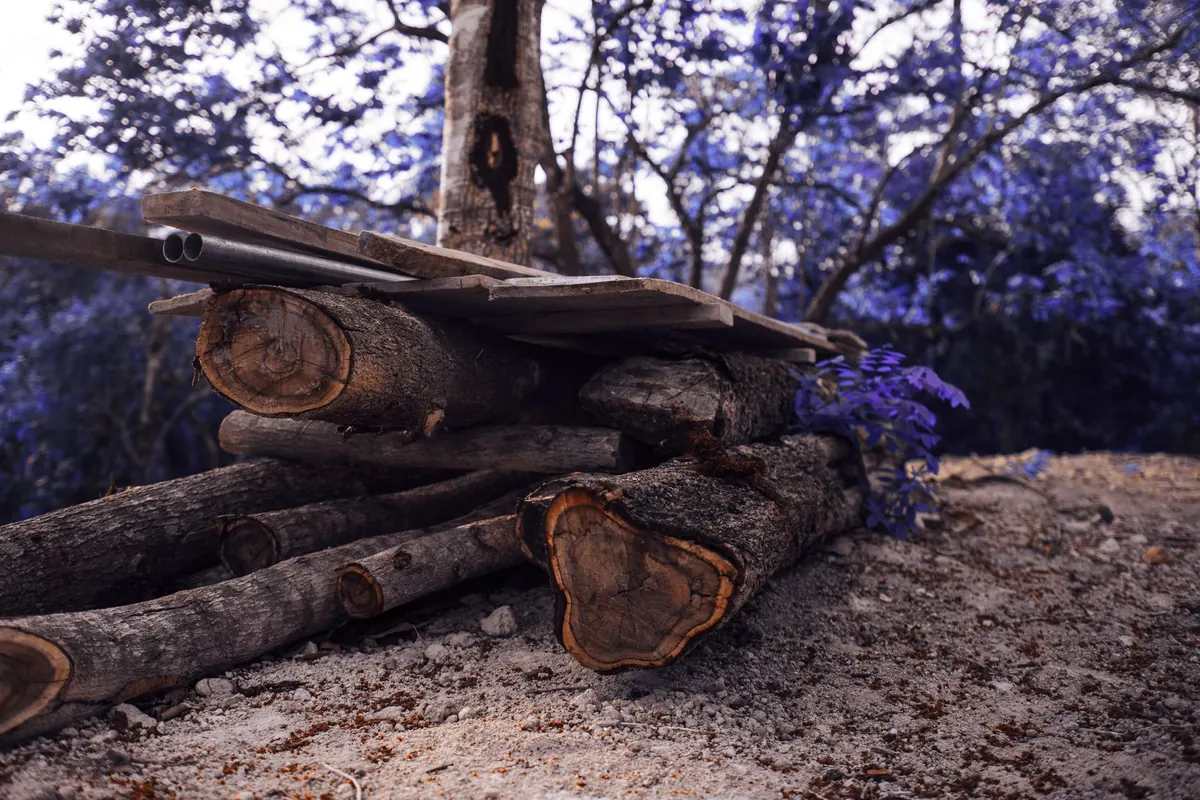
- Lay the next layer across them at right angles, like a very rough log cabin, and keep some gaps.
- Pack the middle with smaller branches, twigs, woodchip and leaves as you build upwards.
- Add a third and fourth layer of progressively smaller logs. Stop somewhere between 50 and 75 cm high, which is enough depth to hold a steady temperature inside.
- Pile leaves and a little soil around the base, and set two or three flat stones nearby for slow worms and beetles to bask on.
Neatness is not required. Before you walk away, kneel down and look at the pile from a frog's point of view: are there dark, damp gaps at ground level? If there are, it will work. If you can bear to, sink two or three logs half into the soil as well, since some beetle larvae need wood that is in contact with damp earth.
Three variations worth trying
The buried log
Part-bury a single large log in a shady border, leaving a third of it showing. It rots slowly, stays reliably damp, and can be surprisingly productive for beetles and fungi without taking up much room.
The stumpery
An old tree stump, or a small group of them, left in place with the roots intact. Roots create crevices, and crevices create shelter. Add a few ferns or foxgloves around the base and you have a feature rather than a mess.
The small-space pile
No garden? A short stack of 15–20 cm logs in a corner of a balcony, courtyard or even a decent-sized planter will still be used by insects. Keep it out of full sun, add leaf litter between the logs, and water the base during dry spells.
Looking after it, and leaving it alone
The best maintenance here is neglect. Resist the urge to tidy, restack or clear the leaves away; the pile is supposed to be sinking, damp and slowly disappearing. Add a log or a bucket of prunings each autumn to replace what has rotted down, and check the base in a dry summer — a slow soak with a watering can helps if the spot is at all exposed.
Two safety points. Never burn a pile that has been sitting for months without moving it by hand first, piece by piece: hedgehogs, toads and newts hibernate deep inside, and fire is a horrible end for them. And do not put food scraps in or near the wood. A clean log pile rarely attracts rats; a pile with a food supply beside it usually will.
Then watch. Wrens and robins work the edges, flicking leaves. A slow worm appears under a flat stone on a warm morning. In autumn the fungi arrive, and by spring you can turn one loose log — only one — to see the tunnels and galleries underneath. That small mess in the corner is doing more for your local wildlife than most of the things you will do in the garden this year.
Photo: Luis Quintero / Pexels

Getting Started with Birdwatching in Woodlands
A practical beginner's guide to woodland birdwatching: the kit worth carrying, the best times to go, and...
A Year in the Woodland: Monthly Nature Checklist
A month-by-month guide to UK woodlands, from January catkins and April bluebells to autumn fungi and the...